The Living Line Method
It bends without becoming formless.
A line appears everywhere. The line of the body. The line between two people. The trajectory of a strike. The changing geometry of a flexible weapon. The line created by rope. The boundary that makes trust possible. The route through an environment. The distance between danger and safety.
There is the line between discipline and rigidity. The line between freedom and chaos. The line connecting intention to action.
The Living Line is not fixed. It responds. It maintains structure without becoming rigid.
The four principles guide how this works in practice. Structure organizes the body and attention. Awareness keeps perception ahead of reaction. Flow lets that structure move with changing conditions. Agency keeps you the one choosing inside all of it.

The Horizon of Awareness
Perception extending to the outer perimeter
Each principle is a line of its own.
Structure
A foundation strong enough to act from. Structure is not stiffness. It is the underlying organization that lets you respond instead of collapse. Without it, there is nothing to adapt. With too much of it, adaptation becomes impossible. The practice is finding structure that holds under pressure and still moves.

Awareness
Seeing what is actually happening before reacting to it. Most reaction is perception that arrived late. Awareness shortens the gap between event and response. It is trained by attention, by presence, and by repeatedly choosing to look before you act.

Flow
Adapting intelligently as conditions change. Conditions always change. Flow is not the absence of structure but structure that knows how to move. It is the capacity to keep your organization intact while the ground shifts underneath you.

Agency
Retaining the ability to choose and act deliberately. Under enough pressure, choice narrows until it disappears. The practice is keeping it open longer than the situation expects, so that even inside constraint you remain the one deciding.

Physical instruments of constraint and flow.
The method uses specific physical tools to test and cultivate capability under pressure. Each one embodies a specific lesson in voluntary constraint, geometry, or adaptation.
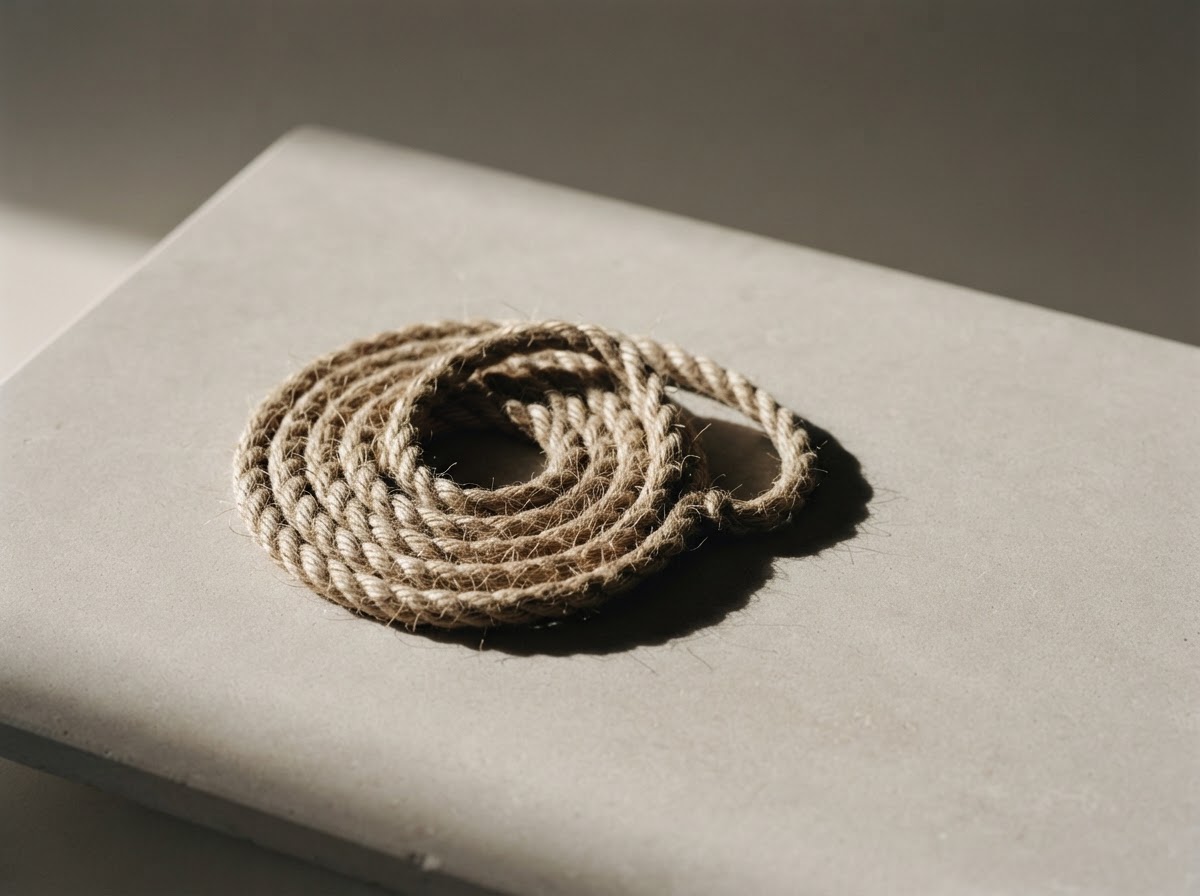
Rope
Natural fiber & static line
Studied through voluntary constraint as an embodied inquiry into trust, communication, tension, structure, attention, and release. It is an optional, consenting adult practice and asks the central paradox: how much structure creates freedom?

Nunchaku
Oak with chain link
Demands constant awareness of moving geometry, rotational torque, and the line between self and object. Unlike rigid weapons, it offers no margin for delayed perception.

San Setsu Kon
Cherry wood, three sections
A three-section staff requiring dynamic adaptation at varied distances. It teaches non-linear momentum control, redirection, and agency through fluid transitions.
Many traditions, one pattern.
Living Line draws on several domains. They are not identical, and the method does not pretend they are. Each teaches a version of the same underlying lesson.

A Synthesis
Learning from traditions, not claiming them.
Living Line is a synthesis. It draws useful principles from martial traditions, wilderness practice, emergency preparedness, endurance disciplines, and systems thinking. Publicly available military and Special Operations principles may inform study: simplicity, adaptability, preparation, situational awareness, decentralized decision-making, functioning under pressure, restraint, mission clarity, and after-action learning.
It does not claim ownership over the traditions it learns from. It is not another conventional martial art, and it does not replace established instruction. It is an evolving embodied method synthesizing principles Christopher has studied and practiced across different domains of his life.
Capability is governed by restraint.
Capability governed by restraint.
The method is not built around domination, aggression, or fantasies of violence. Martial training includes potentially dangerous techniques and tools. The practice emphasizes responsibility, control, protection, escape, proportionality, and disciplined capability.
- Awareness before reaction.
- Avoidance before confrontation.
- Mobility before entrapment.
- Adaptability before rigidity.
- Control before force.
- Agency under pressure.